
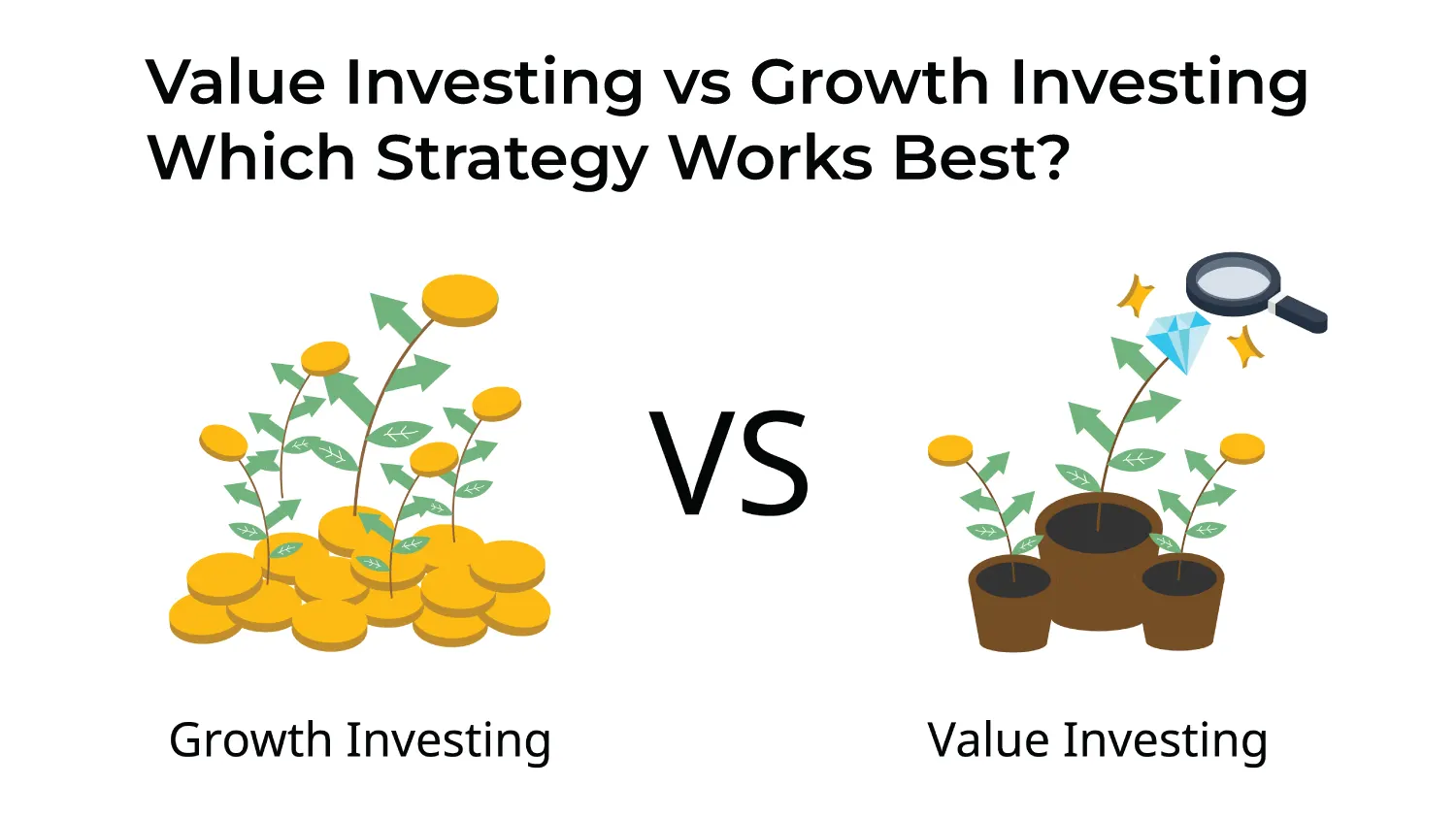
The stock market has always been a dynamic and ever-evolving ecosystem, offering investors multiple ways to grow wealth. Two of the most debated investment styles are value investing and growth investing. Each strategy has produced legendary investors and impressive returns, but they work differently depending on market conditions, risk tolerance, and financial goals.
In this blog, we’ll break down the differences between value and growth investing, compare their strengths and weaknesses, and help you decide which strategy might suit you best. At Investo Pedia 360, we focus on guiding investors through clear, actionable insights so you can make smarter financial decisions in today’s volatile market.
What is Value Investing?
Value investing is an investment approach that involves buying stocks that appear undervalued compared to their intrinsic worth. Investors believe these stocks are temporarily mispriced by the market and expect their prices to rise over time.
Key Characteristics of Value Investing
- Focus on fundamentals like earnings, cash flow, and book value.
- Preference for undervalued stocks trading below intrinsic value.
- Long-term horizon—patience is a critical factor.
- Often pays attention to dividend-paying companies.
Famous Value Investors
- Warren Buffett – Known as the “Oracle of Omaha,” Buffett is the most prominent value investor.
- Benjamin Graham – The father of value investing and author of The Intelligent Investor.
- Charlie Munger – Vice-chairman of Berkshire Hathaway, known for rational long-term investing.
What is Growth Investing?
Growth investing focuses on companies expected to grow faster than the market average. These companies typically reinvest profits to fuel expansion rather than pay dividends.
Key Characteristics of Growth Investing
- Focus on high-revenue growth companies.
- Preference for firms with innovative products, disruptive technologies, or expanding market share.
- Willingness to pay a premium for future earnings potential.
- Typically less emphasis on current profitability and more on future growth prospects.
Famous Growth Investors
- Philip Fisher – A pioneer of growth investing, author of Common Stocks and Uncommon Profits.
- T. Rowe Price Jr. – Considered the father of growth investing.
- Many modern venture capitalists also follow growth investing principles.
Value vs Growth Investing: A Detailed Comparison
| Factor | Value Investing | Growth Investing |
|---|---|---|
| Risk Factor | Lower (stable companies) | Higher (volatile, high expectations) |
| Time Horizon | Long-term, patient approach | Long-term, but with faster growth expectations |
| Return Potential | Moderate, steady returns | Higher potential, but riskier |
| Market Sensitivity | Performs well in downturns | Performs well in bull markets |
| Examples | Banking, utilities, manufacturing | Tech companies, startups, healthcare |
This comparison shows that while growth stocks shine in booming markets, value stocks often provide stability during downturns.
The Ever-Evolving Stock Market: Impact on Both Strategies
The stock market constantly shifts based on global events, economic cycles, and investor sentiment. In some decades, growth stocks dominate (like the tech boom of the 2010s), while in others, value stocks lead (such as after financial crises when undervalued stocks rebound strongly).
For example:
- During 2020–2021, growth stocks like Tesla and Amazon soared due to digital transformation.
- By 2022–2023, rising interest rates and inflation gave value stocks a comeback, as investors sought stability.
This demonstrates that neither strategy permanently outperforms; instead, market cycles determine leadership.
Pros and Cons of Value Investing
Pros:
- Safer during market volatility.
- Often provides dividend income.
- Encourages disciplined, long-term investing.
Cons:
- Requires patience—stocks may remain undervalued for years.
- Lower short-term returns.
- Value traps: some companies are cheap for a reason.
Pros and Cons of Growth Investing
Pros:
- Potential for high returns.
- Exciting opportunities in innovative industries.
- Can outperform significantly in bullish markets.
Cons:
- High volatility.
- Overvaluation risk—stocks may be overpriced.
- Lower or no dividends, as profits are reinvested.
Which Strategy Works Best for You?
The choice between value and growth investing depends on your risk appetite, goals, and timeline.
- If you prefer stability and steady returns, value investing is ideal.
- If you can handle volatility and want higher growth, growth investing may be a better fit.
- Younger investors often lean toward growth due to longer time horizons, while retirees may prefer value for income and stability.
Hybrid Approach: Combining Value and Growth Investing
Many successful investors combine both strategies. This balanced portfolio approach allows exposure to innovative companies while also maintaining stability with undervalued stocks. For instance, you might allocate:
- 50% in stable, dividend-paying value stocks.
- 50% in fast-growing tech or healthcare stocks.
This hybrid strategy balances risk and reward, adapting to ever-changing market cycles.
Final Thoughts
There is no single “best” investment strategy. Both value investing and growth investing have their strengths and weaknesses. The key is understanding your personal risk profile, financial goals, and the current stock market environment.
At Investo Pedia 360, we encourage investors to stay informed and flexible. The ever-evolving stock market demands adaptability—sometimes growth will outperform, and other times value will shine. A balanced, disciplined approach often proves to be the smartest path.
FAQs
Q1. Is value investing safer than growth investing?
Yes, value investing is generally considered safer because it focuses on undervalued, stable companies. However, it also offers slower growth compared to growth investing.
Q2. Can I combine value and growth investing in one portfolio?
Absolutely. Many investors follow a hybrid approach to balance risk and reward, taking advantage of both strategies.
Q3. Which performs better during market downturns?
Value investing usually performs better during downturns, as these companies tend to be more resilient. Growth stocks, on the other hand, are more vulnerable to market volatility.
Q4. Do growth stocks pay dividends?
Most growth stocks reinvest profits into expansion rather than paying dividends. Value stocks are more likely to offer consistent dividends.
Q5. Which is better for long-term investors?
Both strategies can work long-term. Growth stocks may offer higher returns over decades, while value stocks provide stability and income. A balanced approach often works best.
Q6. How do I know which strategy suits me?
Evaluate your risk tolerance, financial goals, and time horizon. Conservative investors may prefer value, while aggressive investors may lean toward growth.